


Paint-Grade Talc for Paints & Coatings
PAINT GRADE TALC
Talc powders developed for paints and coatings where smoothness, rheology, coverage, barrier contribution and consistent dispersion matter.
Architectural Coatings · Industrial Coatings · Primers & Putties
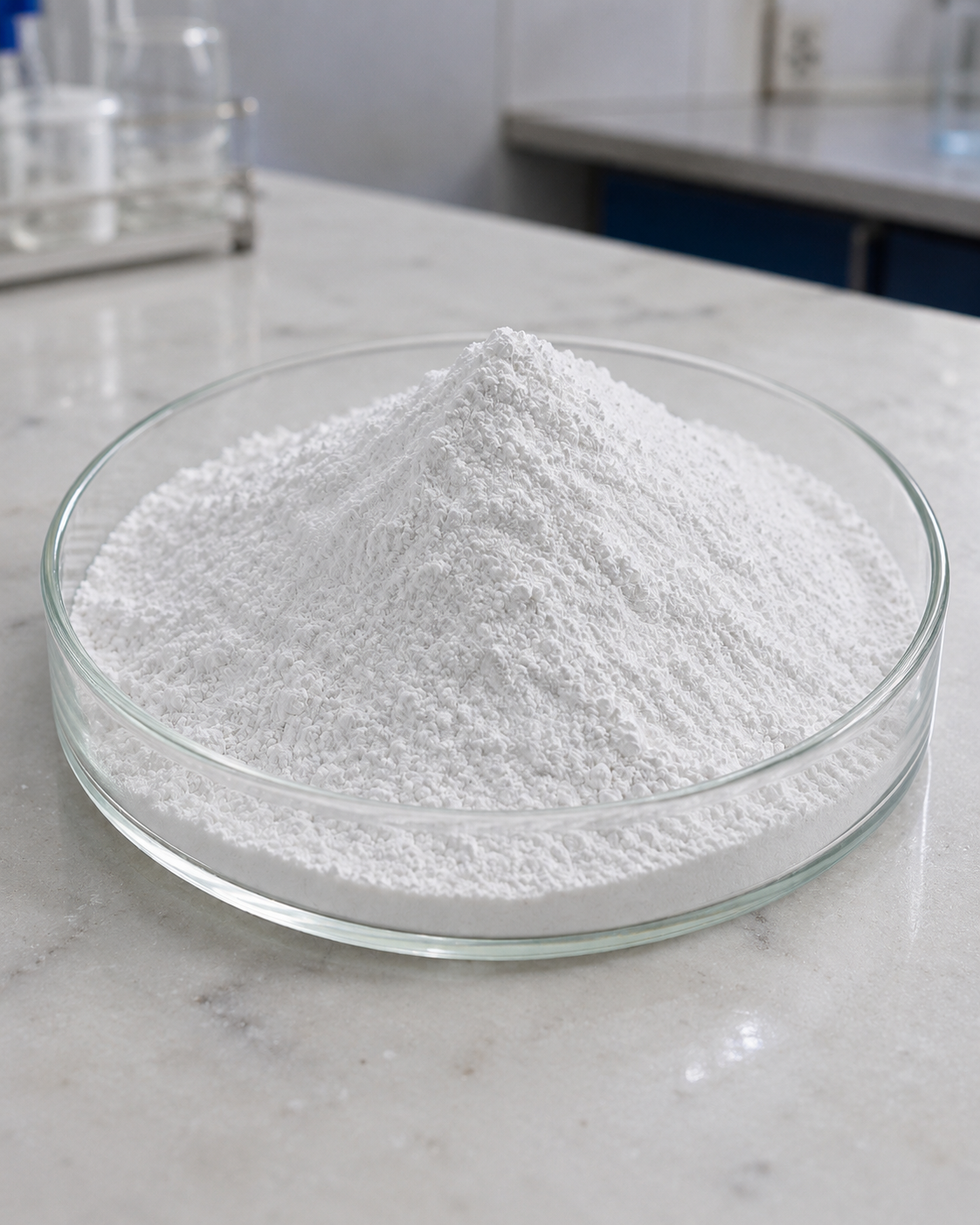
Lamellar Morphology
Plate-like mineral structure
Controlled Particle Profile
Grade-specific particle-size distribution
Optical Consistency
Controlled brightness, whiteness and undertone
Technical Documentation
PIS · TDS · SDS · Batch-specific COA
Functional mineral performance for coating systems.
THE BMM APPROACH
A paint-grade talc is not defined by fineness alone. Mineral character, lamellarity, particle-size distribution, optical properties and dispersion behaviour all influence the result.
Lamellar barrier contribution
Plate-like mineral morphology can increase the path through a properly formulated coating film.
Rheology and suspension
Particle profile and mineral character influence viscosity development, settling behaviour and application properties.
Optical balance
Controlled brightness, whiteness and undertone support white, pastel and pigmented coating systems.
Dispersion and incorporation
Controlled grinding and classification support consistent incorporation and production behaviour.
Surface finish
The selected particle profile can support smoothness, sanding response and uniform film appearance.
Mineral consistency
Controlled sourcing and processing support repeatable chemical, optical and physical characteristics.
COATING APPLICATIONS
Start with the coating.
Refine by specification.
Share where the talc enters your system and what the finished coating needs to achieve.
Coverage & application
Talc grades selected around film build, application rheology, coverage and repeatable production behaviour.
Compare suitable grades →Barrier contribution
Lamellar mineral character can help create a more tortuous path through the coating film, subject to formulation design.
Discuss your coating →Smoothness & control
Particle profile and dispersion are aligned with surface finish, sanding response, loading and process consistency.
Compare suitable grades →PAINT-GRADE PORTFOLIO
Paint-grade talc for diverse coating requirements.
Explore grades differentiated by particle profile, optical characteristics, bulk-density behaviour and intended coating application. Detailed technical specifications are available on enquiry.

Premium Fine-Particle Grade
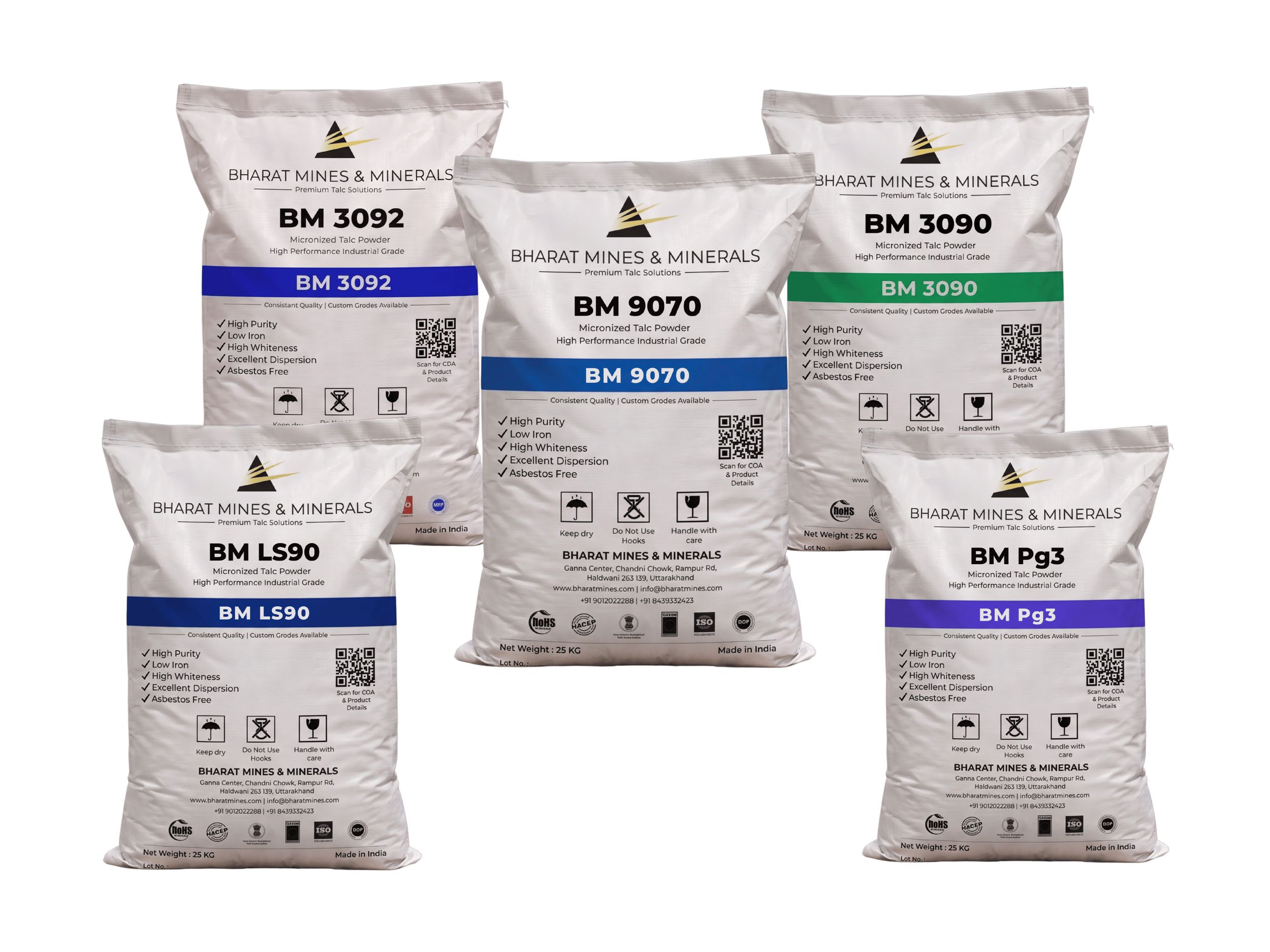
BM 9070
BM 9070 is a premium fine-particle talc with the portfolio’s highest optical profile. Its controlled particle distribution and lamellar mineral character support uniform incorporation, smooth film appearance, gloss control and dependable processing in premium decorative, industrial and specialty coatings.

Fine-Particle Functional Grade
BM Pg3
BM Pg3 combines a fine particle profile with balanced optical properties and lower bulk-density characteristics. It supports uniform incorporation, smooth surface finish, controlled gloss and formulation consistency in decorative paints, primers, putties, texture coatings and general-purpose industrial systems.

Enhanced-Whiteness Grade
BM 3092
BM 3092 is an enhanced-whiteness paint-grade talc for decorative and general industrial coatings. Its controlled particle profile supports uniform dispersion, formulation body, smooth application and a cleaner surface appearance in emulsion paints, primers, undercoats and wall putties.

General-Purpose Grade
BM 3090
BM 3090 is a balanced, general-purpose paint-grade talc developed for cost-conscious coating systems. Its controlled particle profile supports dispersion, formulation body, gloss control, smooth application and consistent processing in decorative paints, primers, putties, distempers and industrial coatings.

Economy Extender Grade
BM LS90
BM LS90 is an economical mineral extender for putties, primers, distempers and texture coatings. Its broader particle profile, controlled oil absorption and higher-density characteristics support formulation body, surface texture, application and sanding performance in cost-sensitive coating systems.
Application-Specific Development
Customised Grades
Looking for a different balance of particle size, optical properties, bulk density or mineral composition? We can evaluate customised paint-grade talc requirements against your formulation objectives, technical specifications, trial quantities and commercial volumes.
GRADE COMPARISON
Compare grades by coating priorities.
Begin with the required particle profile, optical appearance, packing behaviour and functional objective. Final selection should be confirmed through customer formulation trials.
Swipe horizontally to compare all paint-grade selection criteria.
| Grade | Particle Profile | Optical Positioning | Bulk-Density Family | Suggested Starting Point |
|---|---|---|---|---|
| BM 9070 | Very fine | Highest optical profile | Lower-density | Premium decorative paints, industrial coatings and specialty coating systems |
| BM Pg3 | Fine | Balanced optical profile | Lower-density | Decorative paints, primers, undercoats and texture coatings |
| BM 3092 | Standard | Enhanced-whiteness profile | Higher-density | Emulsion paints, interior and exterior paints, primers and wall putties |
| BM 3090 | Standard | Core optical profile | Higher-density | Interior decorative paints, primers, distempers and general-purpose coatings |
| BM LS90 | Broader | Economy optical profile | Higher-density | Wall putties, economy paints, primers, distempers and masonry coatings |
These categories represent qualitative portfolio positioning. Numerical particle-size, optical, bulk-density and chemical values should be reviewed in the relevant grade documentation and confirmed through customer formulation trials.
MINERAL FUNCTION
Plate-like structure.
Functional contribution.
Talc’s layered mineral structure gives it a plate-like morphology. In a suitable coating formulation, these particles can influence rheology, surface characteristics and the path through the film.
Mineralogy alone does not determine performance. Particle profile, dispersion, binder compatibility, loading and film formation must be considered together.

Illustrative talc crystal structure showing its layered mineral character.
TYPICAL CHEMICAL PROFILE
Consistent mineral chemistry supports reliable coating performance.
The balance of silica and magnesium oxide reflects talc’s characteristic mineral composition. For paint and coating applications, chemical consistency should be evaluated alongside particle-size distribution, lamellar morphology, oil absorption, optical properties, moisture and performance within the final formulation.
| Parameter | Typical Range |
|---|---|
| Silica — SiO2 | 59–61% |
| Magnesium Oxide — MgO | 28–31% |
| Alumina — Al2O3 | 0–1.0% |
| Iron Oxide — Fe2O3 | 0–1.0% |
| Calcium Carbonate — CaCO3 | 5–8% |
| Loss on Ignition at 1050°C | 8-10% |
Values are indicative and may vary by grade. Grade-specific technical specifications and supporting documentation are available on enquiry.
TECHNICAL & COMMERCIAL SUPPORT
From shortlist
to supply.
Share your coating system and specification. Our team can support grade discussion, sample evaluation, documentation, packaging and supply planning.
Grade discussion
Review the binder, coating type, loading, process and target film properties.
Samples & evaluation
Shortlist candidate grades for customer-side formulation and performance trials.
Documentation
Product specifications, TDS, SDS and batch-specific COA support.
Supply planning
Suitable packaging with domestic dispatch and export coordination support.
COMMON QUESTIONS
Before you request a grade.
-
Please share the coating type, water- or solvent-based system, binder, current mineral or grade, target loading, application method, desired film properties and any specification or documentation requirements.
-
Depending on mineral character and formulation, talc can contribute to rheology, coverage, smoothness, barrier behaviour and processing consistency. The result depends on the complete formulation and should be validated by the customer.
-
Yes. We can discuss the application, process and target properties, then identify a practical starting grade for customer evaluation.
-
Product specifications, TDS, SDS and batch-specific COA support can be discussed for the selected grade. Availability should be confirmed during the enquiry.
What should your talc help you achieve?
START A TECHNICAL CONVERSATION
Share your application, current specification, target properties, approximate requirement and destination. Our team will review the information and recommend the appropriate next step.
Product selection · Technical data · Samples · Domestic supply · Export enquiries
SALES & TECHNICAL ENQUIRIES
Ganna Center, Chandni Chowk, Rampur Rd, Haldwani 263 139,
Uttarakhand